Architecture Overview
Overview
Section titled “Overview”FrameWorks runs the same service topology in every environment — local, staging, production, self-hosted — and varies only the deployment substrate:
- Local development: Docker Compose brings up the full stack on one host.
- Production and self-hosted: The FrameWorks CLI (
frameworks cluster provision) drives Ansible roles against the hosts named in the cluster manifest. Release manifests live in a GitOps repository; the CLI reads them to pin versions and reconcile state. See CLI Reference and Ansible Provisioning. - Coordination: Quartermaster is the runtime source of truth for tenants, clusters, and service discovery; every other service queries it rather than holding its own copy of routing state.
Multi-Plane Architecture
Section titled “Multi-Plane Architecture”FrameWorks uses a multi-plane distributed architecture designed for scale, separating tenant-facing control logic from high-volume media, event data, and network automation. Plane names describe runtime responsibility; deployment tiers describe placement.
- Control / API Plane: GraphQL aggregation, auth, stream management, tenant routing, and billing APIs.
- Media Plane: Media ingest, processing, playback routing, edge orchestration, and media asset delivery.
- Event & Analytics Plane: Event ingress, Kafka fan-out, real-time fan-out, and analytical storage/querying.
- Network & Trust Plane: Public DNS, certificates, service identity, mesh networking, and ingress.
- Support & Experience Services: Support workflows, AI consultant workflows, forms, newsletters, and stream interaction services.
- Interfaces: Web apps, marketing sites, documentation, CLI, SDKs, and player/studio packages.
- Observability & Operations: Metrics, dashboards, alerting, BI, and incident workflows.
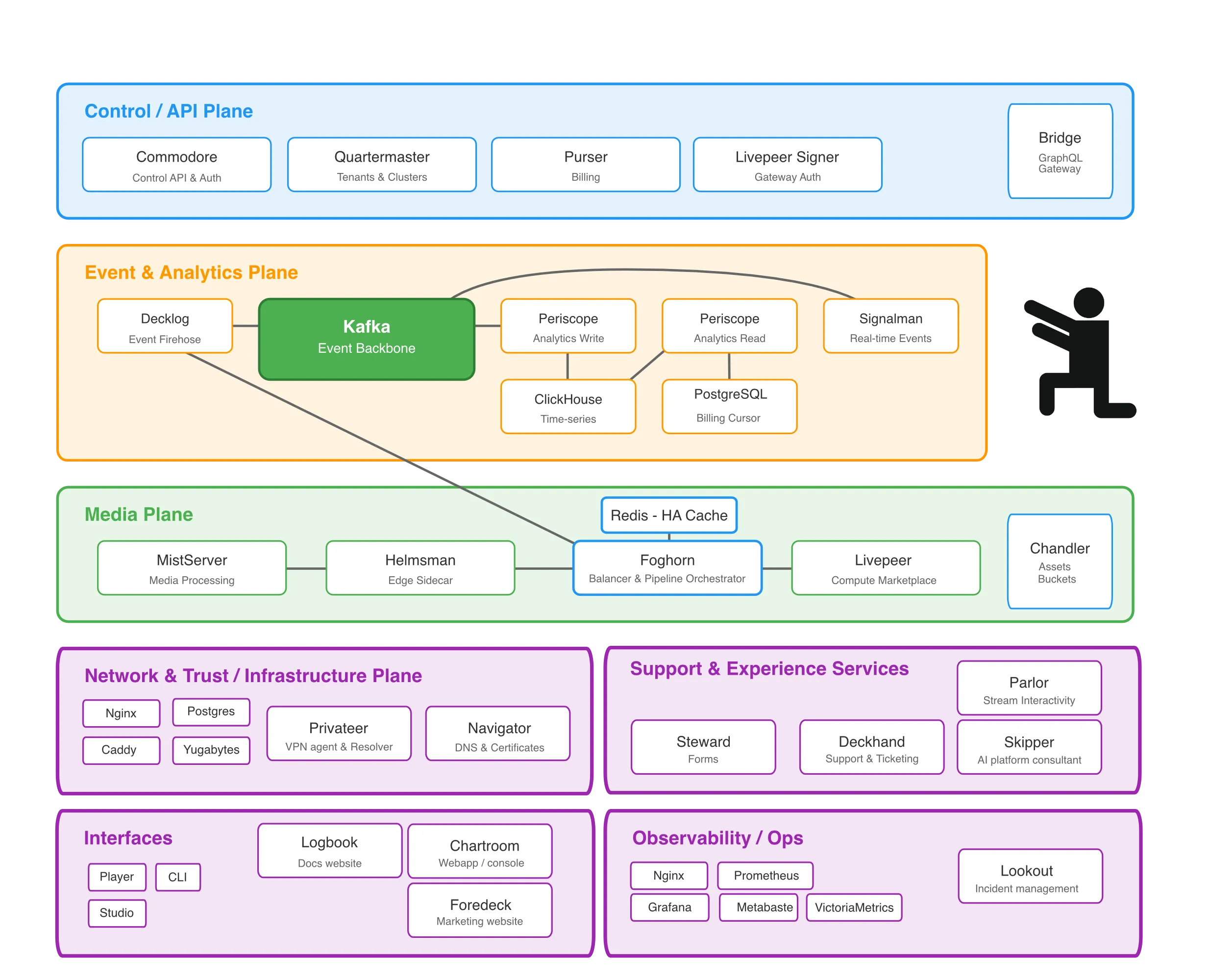
Service Stack
Section titled “Service Stack”The FrameWorks platform is composed of specialized services, each responsible for a distinct domain. These services communicate primarily via gRPC for internal traffic and expose a unified GraphQL API for external clients.
Core Services
Section titled “Core Services”| Service | Port(s) | Tier | Plane | Purpose |
|---|---|---|---|---|
| Bridge | 18000 | Regional | Control / API | GraphQL API Gateway and MCP hub |
| Commodore | 18001 (HTTP), 19001 (gRPC) | Central | Control / API | Auth, streams, API tokens, media registry, and business workflows |
| Quartermaster | 18002 (HTTP), 19002 (gRPC) | Central | Control / API | Tenants, clusters, nodes, service discovery, and bootstrap state |
| Purser | 18003 (HTTP), 19003 (gRPC) | Central | Control / API | Billing, usage, invoices, payments, and x402 state |
| Periscope Query | 18004 (HTTP), 19004 (gRPC) | Central | Event & Analytics | Analytics and reporting API |
| Periscope Ingest | 18005 | Regional | Event & Analytics | Kafka event processing and ClickHouse writes |
| Decklog | 18006 (gRPC) | Regional | Event & Analytics | gRPC event ingress → Kafka |
| Decklog (metrics) | 18026 | Regional | Observability & Operations | Decklog Prometheus metrics |
| Signalman | 18009 (WS), 19005 (gRPC) | Regional | Event & Analytics | Real-time event fan-out and WebSocket hub |
| Foghorn | 18008 | Regional | Media | Load balancer and media pipeline orchestrator |
| Foghorn (internal gRPC) | 18019 (gRPC) | Regional | Media | Internal control API and HA relay over the internal CA |
| Foghorn (external gRPC) | 18029 (gRPC) | Regional | Media | Edge bootstrap, Helmsman control, and FoghornFederation over ACME |
| Helmsman | 18007 (HTTP) | Edge | Media | MistServer sidecar |
| Chandler | 18020 (HTTP) | Regional | Media | Cluster-scoped static media asset server |
| Navigator | 18010 (HTTP), 18011 (gRPC) | Central | Network & Trust | Public DNS, ACME certificates, and internal CA material |
| Privateer | 18012 (HTTP) | Central/Regional | Network & Trust | WireGuard mesh agent and local .internal DNS |
| Deckhand | 18015 (HTTP), 19006 (gRPC) | Central | Support & Experience Services | Support messaging API (Chatwoot adapter) |
| Skipper | 18018 (HTTP), 19007 (gRPC) | Central | Support & Experience Services | AI video consultant API |
| Forms | 18032 | Central | Support & Experience Services | Contact form and newsletter handling |
Infrastructure Components
Section titled “Infrastructure Components”| Component | Role | Plane | Port(s) | Deploy Location |
|---|---|---|---|---|
| MistServer | Media processing, ingest, and edge delivery | Media | 4242, 8080, 1935, 5554, 4200, 8889/udp, 18203/udp | Edge |
| Livepeer Gateway | Transcoding gateway and compute-marketplace integration | Media | 8935 | Edge (co-located with MistServer) |
| Livepeer Signer | ETH transaction signer for gateway | Control / API | 18016 | Central |
| PostgreSQL-compatible DB (Postgres/Yugabyte) | Service-owned state and configuration database substrate | Infrastructure | Operator-defined | Central |
| ClickHouse | Time-series analytics database | Event & Analytics | 8123 (HTTP), 9000 (Native) | Central |
| Kafka | Event streaming backbone | Event & Analytics | 9092 (Int), 29092 (Ext) | Central + Regional (single shared cluster) |
| Foghorn Redis | Foghorn HA state sync | Media | 6379 | Regional |
| Nginx | Reverse proxy and local development routing | Network & Trust | 18090 | Central |
| Caddy | Edge TLS termination and reverse proxy | Network & Trust | 80, 443, 18090 | Edge |
| VictoriaMetrics + vmagent | Metrics collection and remote-write fan-in | Observability & Operations | Operator-defined | Central + every backend and edge host |
| Grafana | Metrics visualization | Observability & Operations | Operator-defined | Central |
| Metabase | BI analytics | Observability & Operations | Operator-defined | Central |
| Listmonk | Newsletter and mailing list manager | Support & Experience Services | 9000 (service), 9001 (docker-compose host) | Central |
Livepeer integration: The Livepeer Gateway is provisioned via the CLI and discovered via Quartermaster service discovery. MistServer sends segments to the gateway automatically when Livepeer transcoding is configured for a stream. Ingest auth stays in the media plane: the gateway calls Foghorn’s internal /webhooks/livepeer/auth webhook, and wallet/top-up automation reads wallet_address from Quartermaster service-instance metadata.
Interfaces
Section titled “Interfaces”| Component | Role | Path | Port | Deploy Location |
|---|---|---|---|---|
| Chartroom / Web Console | SvelteKit user dashboard | website_application | 18030 | Regional |
| Foredeck / Marketing | Sales / Marketing website | website_marketing | 18031 | Regional |
| Logbook / Documentation | Astro Starlight docs site | website_docs | 18033 | Central |
| NPM Player | Embeddable multi-protocol player | npm_player | N/A (npm package) | User websites |
| NPM Studio | Embeddable browser ingest studio | npm_studio | N/A (npm package) | User websites |
| Android App | Native mobile client (in development) | app_android | N/A | Roadmap |
CLI Tool
Section titled “CLI Tool”| Component | Role | Path | Install |
|---|---|---|---|
| FrameWorks CLI | Cluster management and provisioning | cli/ | go install or binary |
Deployment Tiers
Section titled “Deployment Tiers”- Central: Commodore, Quartermaster, Purser, Navigator, Periscope Query, Deckhand, Skipper, Forms, PostgreSQL-compatible DB (YugabyteDB recommended), ClickHouse, Listmonk, Chatwoot + Redis.
- Regional: Bridge, Foghorn, Decklog, Periscope Ingest, Signalman, Chandler, Kafka, Web Console, Marketing Site.
- Central/Regional: Privateer (WireGuard mesh agent runs on all backend infrastructure nodes).
- Edge: MistServer, Helmsman, Livepeer Gateway.
Multi-Cluster Topology
Section titled “Multi-Cluster Topology”FrameWorks supports multiple clusters. A cluster is a Foghorn instance (or HA pair) plus its edge nodes — strictly the media plane. All clusters share the same central Control / API Plane (Commodore, Quartermaster, Purser) and Event & Analytics Plane (Decklog, Periscope, Signalman). These services are not duplicated or federated per cluster.
Cross-cluster coordination is handled exclusively by the FoghornFederation gRPC protocol between Foghorn instances:
- Peer discovery: Quartermaster maintains a registry of all clusters. Foghorn queries
ListPeersto find peers and opensPeerChannelbidirectional streams for real-time edge telemetry exchange. - Cross-cluster viewer routing: When a viewer’s cluster doesn’t have a stream, Foghorn uses
QueryStreamto find it on a peer, then either redirects the viewer or arranges a DTSC origin-pull to serve locally. - Cross-cluster artifacts: clips, VODs, and DVR chapters on remote clusters are all accessed via
PrepareArtifact. Origin returns a presigned S3 URL when the artifact is synced, or a short-lived peer-relay URL + opaque capability grant pointing at the specific origin node when the canonical file is on disk but S3 sync is still pending (the origin Foghorn authorizes each pull online; no signing key on the edge) — viewers don’t wait on sync. DVR chapter listing flows through the GraphQL chapter API (Commodore → origin Foghorn for the chapter row metadata); each finalized chapter is a regular VOD-shaped artifact with its own Commodore-minted publicplaybackId, so chapter playback follows the same federation rules as any other VOD. - Leader-only peering: Each cluster elects one Foghorn instance (via Redis SET NX) to run PeerChannel connections, avoiding duplicate peer traffic.
Quartermaster is the sole routing authority. Commodore resolves tenant-to-cluster routing dynamically via GetClusterRouting — no hardcoded Foghorn addresses between services.
Deployment models:
| Model | Description |
|---|---|
| Shared | Free shared capacity is currently unmetered; premium shared tiers are seeded for later enforcement. All tenants share the same cluster, edges, and services. |
| Dedicated | Enterprise tier. Isolated cluster with dedicated Foghorn, edges, and capacity — operated by FrameWorks or self-hosted on-premise via the CLI, with Manual Deployment as an advanced reference. |
| Hybrid | Tenant runs self-hosted edges that fall back to the primary shared cluster. Edges federate via Foghorn; control/data plane remains shared. |
| Open Marketplace | Operators publish listed clusters with access controls, invites, subscription requests, and pricing metadata. Tenants browse listings and subscribe through the dashboard or API. |
Data Flow Architecture
Section titled “Data Flow Architecture”Understanding how data moves through the system is critical for operations and troubleshooting. The diagrams below illustrate the key pipelines for analytics, control, and media.
Event-Driven Analytics Pipeline
Section titled “Event-Driven Analytics Pipeline”graph LR
MS[MistServer] --> H[Helmsman]
H <-->|gRPC| F[Foghorn]
F --> D[Decklog]
F -->|gRPC| C[Commodore<br/>validation]
D --> K[Kafka]
K --> PI[Periscope-Ingest]
K --> S[Signalman]
PI --> CH[(ClickHouse)]
S --> FE[Frontend<br/>WebSocket]
Note: Helmsman maintains a persistent bidirectional gRPC stream with Foghorn:
- Helmsman → Foghorn: MistServer triggers, heartbeats, clip/DVR progress updates
- Foghorn → Helmsman: Clip pull requests, DVR start/stop commands, config seeds
Foghorn routes events to central services (Commodore for validation, Decklog for analytics, Quartermaster for tenant resolution).
Control / API Communications
Section titled “Control / API Communications”graph LR
FE[Frontend] --> B[Bridge]
B -->|gRPC| COM[Commodore]
B -->|gRPC| PUR[Purser<br/>billing]
B -->|gRPC| QM[Quartermaster<br/>tenant info]
B -->|gRPC| PER[Periscope Query<br/>analytics]
H[Helmsman] <-->|gRPC| F[Foghorn]
F -->|gRPC| COM2[Commodore<br/>validation]
F -->|gRPC| QM2[Quartermaster<br/>enrollment]
Media Pipeline
Section titled “Media Pipeline”graph LR
IN[RTMP/E-RTMP/SRT/WHIP] --> MS[MistServer]
MS <--> LP[Livepeer<br/>transcoding/AI]
MS --> OUT[Multi-protocol outputs<br/>HLS / LL-HLS / DASH / WebRTC]
OUT --> V[Viewers]
MS --> H[Helmsman]
H --> F[Foghorn]
Viewer Routing
Section titled “Viewer Routing”Foghorn selects optimal edge nodes for viewers based on geography, load, and stream availability.
Routing Paths:
graph LR
    P[Player] -->|GraphQL| B[Bridge]
    B -->|gRPC| C[Commodore]
    C -->|gRPC| F[Foghorn]
    F -->|node list| C
    C --> B --> P
    P -->|connect| E[Edge Node]
| Path | Flow | Use Case |
|---|---|---|
| GraphQL (primary) | Player → Bridge → Commodore → Foghorn | FrameWorks Player, SDK integrations |
| HTTP (direct) | Client → Foghorn /play/{viewkey} | CLI tools, direct URL access, 307 redirects |
Foghorn HTTP Endpoints:
| Endpoint | Response | Use Case |
|---|---|---|
GET /play/{viewkey} | JSON with all endpoints | Direct integration |
GET /play/{viewkey}/hls/index.m3u8 | 307 redirect to edge | Direct HLS playback |
GET /play/{viewkey}/webrtc | 307 redirect to edge | Direct WebRTC (WHEP) |
GET /{viewkey} | Best node host or 307 | MistServer compatibility |
For URI patterns and player integration, see Playback & Embedding.
Infrastructure Layers
Section titled “Infrastructure Layers”graph TB
subgraph "Infrastructure Layers"
SOURCE["Release Source of Truth<br/>GitOps manifests"]
CONFIG["Configuration Layer<br/>Ansible (driven by CLI)"]
ORCH["Coordination Layer<br/>Quartermaster"]
end
subgraph "Components"
VMS["Hosts (BYO or operator-provided)"]
DNS["DNS (Cloudflare / Bunny via Navigator)"]
CERTS["TLS Certificates"]
MESH["WireGuard Mesh (Privateer)"]
SERVICES["FrameWorks Services"]
TENANTS["Tenants & Clusters"]
end
SOURCE --> CONFIG
CONFIG --> VMS
CONFIG --> DNS
CONFIG --> CERTS
CONFIG --> MESH
CONFIG --> SERVICES
ORCH --> TENANTS
ORCH --> SERVICES
Proxy & SSL Strategy
Section titled “Proxy & SSL Strategy”Traffic routing and TLS termination vary by deployment tier:
- Development: Nginx (via Docker Compose) handles local routing with self-signed or no TLS.
- Production (Edge): Caddy serves edge traffic. Bootstrap templates start with internal TLS
and a 503 response; after enrollment, Foghorn pushes SiteConfig and TLS material to Helmsman,
which rewrites and reloads Caddy for viewer traffic.
- Managed via CLI templates (
cli/internal/templates/edge/Caddyfile.tmpl). - Supports HTTP/2, HTTP/3, and WebSocket upgrades natively.
- Managed via CLI templates (
- Production (Central/Regional): Navigator manages public DNS through Cloudflare for root/API/web/admin names and Bunny DNS for delegated media cluster zones.
- Root/API/web/admin names → Cloudflare A records or load balancers
- Multiple root/global nodes → Cloudflare load balancer with one proximity-steered pool per Quartermaster cluster
- Media cluster names → Bunny A-record sets under
{cluster_slug}.{base_domain} - Media cluster records use Bunny geolocation Smart Routing when Quartermaster has node coordinates
- Certificates issued via Let’s Encrypt DNS-01 through the provider authoritative for the name
Note: Cloudflare remains authoritative for root/API/web/admin/support names. Bunny DNS is authoritative for delegated media cluster zones. Traffic flows directly to FrameWorks services; provider-side proxies are not used for media traffic.
Mesh Networking
Section titled “Mesh Networking”Internal communication between nodes uses a WireGuard mesh managed by the Privateer agent (api_mesh). This handles:
- Secure inter-node communication
- Internal DNS resolution
- Backend infrastructure isolation
See Mesh Networking for bootstrap and runtime details.